
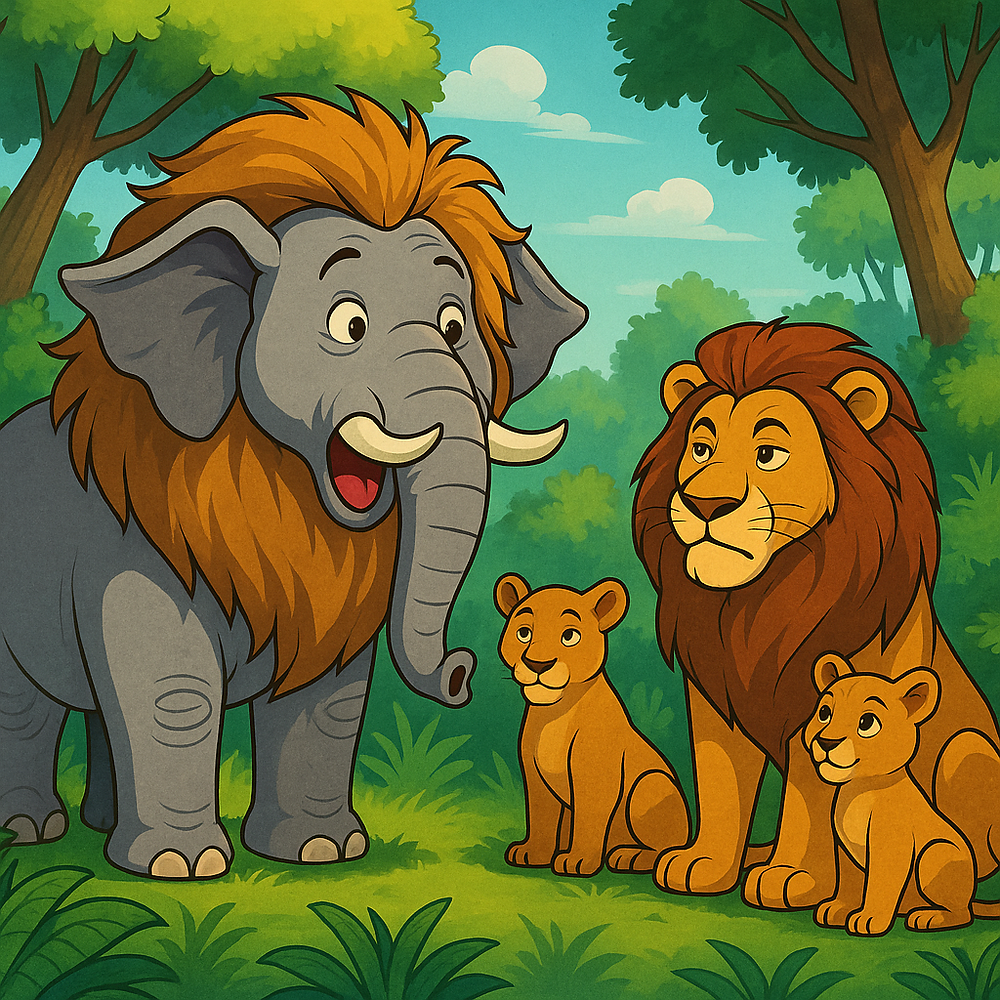
📖🐘 The Tale of Gajendra: The Elephant Who Wanted to Be a Lion 🦁🌿
In the heart of the lush, green jungle of Jambudweep, where the rivers sang and the trees danced, lived a mighty elephant named Gajendra. 🐘🌿 Gajendra was no ordinary elephant; he was the largest, strongest, and most respected creature in the jungle. His tusks were as white as the Himalayan snow, and his trumpet could be heard miles away. 🏔️🎺
Despite his grandeur, Gajendra harbored a secret desire. Deep within, he yearned to be a lion. 🦁💭 He believed that lions were the true kings of the jungle, commanding fear and respect with their majestic manes and thunderous roars. Gajendra thought, "If only I were a lion, I would be the undisputed ruler of this jungle." 🐘➡️🦁👑
One sunny morning, Gajendra approached the Lion's Council, a group of wise old lions who governed the jungle's affairs. 🦁👴👵 He bowed respectfully and said, "Oh noble lions, I seek your wisdom. I wish to become one of you, to learn your ways, and to be accepted as a lion." 🐘🙏🦁
The lions, surprised by Gajendra's request, deliberated among themselves. After much discussion, they agreed to grant Gajendra's wish, but only if he could pass three tests:
The Roar Test: Gajendra had to produce a roar as mighty as a lion's. 🗣️🦁
The Hunt Test: He had to hunt and bring back prey like a lion. 🐾🦌
The Mane Test: He needed to grow a mane as splendid as a lion's. 💇🦁
Gajendra accepted the challenge with determination. 💪🐘
Gajendra practiced day and night, trying to mimic the lion's roar. He inhaled deeply and let out a sound that was a mix between a trumpet and a growl. 🎺😤 The jungle creatures were amused, and some even laughed. 😂🐒
Despite his efforts, Gajendra's roar remained an elephant's trumpet. The lions, observing his attempts, said, "Your voice is unique, Gajendra. It's not meant to be a lion's roar." 🐘🎺🦁
Next, Gajendra attempted to hunt. He tried stalking prey, but his massive size and gentle nature made it impossible. He couldn't bring himself to harm another creature. 🐘❌🦌
The jungle animals noticed his struggle and whispered, "Gajendra is kind-hearted. Hunting isn't in his nature." 🐿️🗣️🐘
For the final test, Gajendra tried to fashion a mane. He adorned himself with vines and leaves, attempting to resemble a lion's mane. 🍃🌿 However, the jungle wind blew away his makeshift mane, revealing his true self. 🌬️🍃
The lions approached him and said, "Gajendra, your strength lies in your uniqueness. You don't need a mane to be majestic." 🦁🐘❤️
Gajendra sat under the Bodhi tree, reflecting on his journey. He realized that trying to be someone else had made him forget his own worth. 🧘🐘
From that day on, Gajendra embraced his identity as an elephant. He used his strength to help build bridges across rivers, his trunk to shower water during droughts, and his wisdom to mediate disputes among animals. 🌉💦🕊️
The jungle celebrated Gajendra, not as a lion, but as the noble elephant who understood the value of being oneself. 🎊🐘🌟
In a world where everyone tries to fit into molds, Gajendra's story teaches us the importance of embracing our true selves. 🧍♂️❤️🧍♀️
This tale mirrors the recent events in India, where the inclusion of caste details in the national census has sparked discussions about identity and representation. Just as Gajendra sought acceptance by trying to be someone else, communities today seek recognition and equality. The story emphasizes that true respect comes from embracing one's identity and working towards inclusivity.
Sources
This is an AI-generated story and may contain errors. Verify important information with original sources.